Cart
0
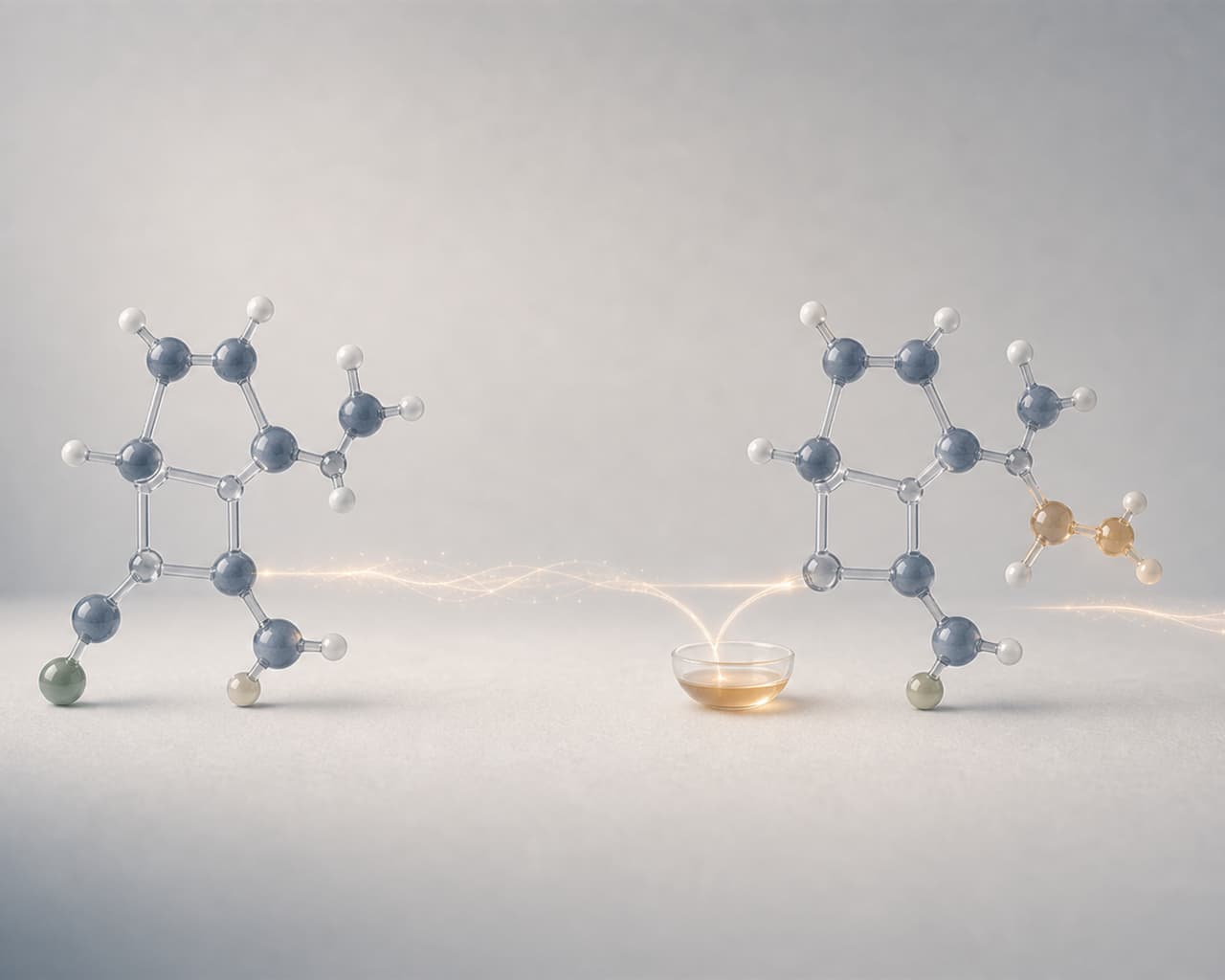
Walk down the amino-acid aisle of any supplement catalogue and you will find tyrosine sold in two forms. One is plain L-tyrosine; the other is N-acetyl-L-tyrosine, usually abbreviated NALT and marketed as the upgraded version, more soluble, more stable, more bioavailable. The implication is that NALT is simply a better way to get tyrosine, interchangeable with the plain form but superior. It is a tidy story, and it happens to be one of the clearest cases in the supplement world of a marketing claim colliding with the actual pharmacology. When you look at how the human body handles N-acetyl-L-tyrosine, the "more bioavailable" framing does not survive contact with the evidence.
Why the form matters at all
Tyrosine is worth taking, when it is worth taking, because it is the precursor from which the brain builds the catecholamine neurotransmitters dopamine and noradrenaline [8]. Its documented value is narrow and conditional: supplementation can protect cognitive performance under acute stress or heavy demand, when catecholamines are being used up quickly, but does little in a calm, rested state [9]. That conditional benefit is the whole reason anyone reaches for tyrosine. And it depends entirely on one thing actually happening: the supplement has to raise the availability of free tyrosine in the body. A form that fails to do that fails at the only job that matters, regardless of how it is marketed. So the question of whether NALT and L-tyrosine are interchangeable reduces to a concrete, testable question: does N-acetyl-L-tyrosine actually deliver tyrosine?
The kernel of truth: solubility
The marketing rationale is not invented from nothing. N-acetyl-L-tyrosine is far more water-soluble than plain L-tyrosine, and that is a genuine chemical advantage. It is precisely why the acetylated form was investigated in the first place, not for oral supplements but for intravenous nutrition, where the poor solubility of plain tyrosine limits how much can be dissolved into a feeding solution [5]. If the goal is to pack tyrosine into a liquid, the acetylated form helps. The error is in assuming that better solubility means better usability inside the body. Getting a molecule dissolved is not the same as getting it converted into the substance you actually need, and that is where NALT runs into trouble.
What humans actually do with N-acetyl-tyrosine
For N-acetyl-L-tyrosine to serve as a tyrosine source, the body has to remove the acetyl group, a step called deacetylation. Humans do this poorly, and the evidence is consistent and unusually direct. When researchers infused N-acetyl-tyrosine intravenously into healthy volunteers, plasma tyrosine rose only slightly while more than half of the infused compound, fifty-six percent, was excreted unchanged in the urine within four hours, and there was no net production of tyrosine from the body's core metabolism; the authors concluded plainly that the usefulness of the acetylated form as a tyrosine precursor in humans "is not apparent" [1]. A second study drove the point home by comparison. It pitted N-acetyl-tyrosine against tyrosine-containing dipeptides and found that plasma tyrosine did not increase at all after N-acetyl-tyrosine, while sixty percent of it was lost in the urine; the dipeptides, by contrast, released their tyrosine readily [2]. A follow-up in patients with liver failure reached the same conclusion, with no rise in plasma tyrosine after N-acetyl-tyrosine and the major part again lost in urine, showing the problem is not simply a matter of liver function [3].
The pattern even survives the shift from intravenous to the oral route more relevant to supplements. When N-acetyl-L-tyrosine is given by mouth or feeding tube, it produces a distinctive appearance of intact N-acetyltyrosine in the urine, a finding clinicians have learned to recognize so as not to mistake it for a metabolic disorder [7]. Ingested N-acetyl-tyrosine, in other words, is substantially excreted as itself rather than fully converted to tyrosine. One clinical study offers the most generous reading available, finding that around thirty-five percent was excreted unchanged, which means it is a partial and inefficient source rather than a completely useless one [4]. Even that charitable figure describes a compound that throws away a large fraction of its tyrosine, which is not what "more bioavailable" is supposed to mean.
The species trap
Part of why the "superior form" claim persists is a genuine biological wrinkle that is easy to cite selectively. Rats handle N-acetyl-tyrosine well. In rodent studies it is rapidly deacetylated and efficiently used, with only modest urinary losses of roughly eight to seventeen percent and good incorporation into the body's tyrosine pools [5], and long-term feeding studies in growing rats found it supported growth about as well as adequate protein, with only around eleven percent lost in urine [6]. If you read only the animal literature, N-acetyl-tyrosine looks like a fine tyrosine source. The trouble is that this is exactly the kind of finding that does not transfer across species, because the enzyme activity that deacetylates these compounds differs markedly between rodents and humans. Citing efficient rat utilization to justify a human supplement is a classic translation error, and it is one the human studies above directly refute.
What plain L-tyrosine does instead
The contrast with the plain form is stark, and it is the other half of the argument. Plain oral L-tyrosine reliably does the one thing a tyrosine source must do. A classic pharmacokinetic study showed that a single oral dose raised plasma tyrosine substantially, with levels climbing for hours after ingestion [14], and a modern dose-response trial confirmed a clear, dose-dependent rise in plasma tyrosine after oral L-tyrosine [13]. This is not surprising, since the availability of a precursor genuinely influences the synthesis of the monoamine neurotransmitters it feeds, which is the mechanistic basis for tyrosine's effects on catecholamine production in the first place [8][15]. Plain L-tyrosine gets into the blood as tyrosine; N-acetyl-L-tyrosine largely does not. On the single criterion that determines whether either form can work, they are not equivalent.
The evidence gap on top of the pharmacokinetic one
There is a second problem with treating the forms as interchangeable, and it compounds the first. Almost every human study demonstrating a cognitive or stress-protective effect of tyrosine used plain L-tyrosine, not the acetylated form. The environmental-stress studies, the military field trials, the working-memory experiments, and the reviews that summarize them all rest on plain L-tyrosine [9][10][11][12][16]. There is no comparable body of human cognitive research showing that N-acetyl-L-tyrosine produces the same benefits. So even if one set aside the pharmacokinetic data, the direct evidence for NALT delivering tyrosine's cognitive effects simply does not exist. The claim of interchangeability asks you to assume that a differently metabolized molecule, which raises plasma tyrosine poorly, nonetheless reproduces effects that were only ever demonstrated with the other form. That is a lot to take on faith.
Being fair to N-acetyl-L-tyrosine
Honesty cuts both ways, and a few caveats are worth stating. Most of the damning pharmacokinetic data come from intravenous or parenteral studies, and the doses and routes there are not identical to a capsule taken with breakfast, so the numbers should be read as strongly suggestive rather than as a perfect model of oral supplementation. The most favorable human study found NALT was a partial source, not a zero source, which means some tyrosine does get through. And no one has shown NALT to be harmful at typical doses. The fair conclusion is not that N-acetyl-L-tyrosine does nothing, but that it is a demonstrably less efficient way to raise tyrosine than the plain amino acid, and that the specific claim of interchangeability is unsupported.
There is also a question the human studies cannot fully settle, which is what happens over weeks of oral dosing rather than a single infusion. It is conceivable that a small, partial conversion adds up with repeated daily use, or that gut and first-pass metabolism handle a swallowed capsule differently from an intravenous drip. But conceivable is not demonstrated, and the direction of every piece of available human evidence points the same way: less tyrosine delivered, more excreted intact. In the absence of a study showing otherwise, the reasonable default is to treat the plain amino acid as the reliable option and the acetylated form as unproven for the purpose people actually buy it for.
The bottom line
Are the two forms interchangeable? On the weight of the evidence, no. N-acetyl-L-tyrosine is genuinely more soluble, which is useful for manufacturing liquids, but in humans it is poorly deacetylated and a large fraction is excreted intact, so it raises tyrosine far less effectively than the plain form. Plain L-tyrosine reliably lifts plasma tyrosine and is the form behind every cognitive and stress-performance study worth citing. Unless and until a human trial shows that N-acetyl-L-tyrosine both raises tyrosine availability and reproduces the cognitive effects, the burden of proof sits squarely on the "upgraded form" claim, and it has not been met. For anyone whose goal is what tyrosine is actually good for, defending performance under acute stress, plain L-tyrosine is the better-supported choice, and the premium form is a solubility solution to a problem most supplement users do not have.
References
[1] Magnusson, I., Ekman, L., Wångdahl, M., & Wahren, J. (1989). N-acetyl-L-tyrosine and N-acetyl-L-cysteine as tyrosine and cysteine precursors during intravenous infusion in humans. Metabolism, 38(10), 957–961. https://doi.org/10.1016/0026-0495(89)90005-X
[2] Druml, W., Lochs, H., Roth, E., Hübl, W., Balcke, P., & Lenz, K. (1991). Utilization of tyrosine dipeptides and acetyltyrosine in normal and uremic humans. American Journal of Physiology, 260(2 Pt 1), E280–E285. https://doi.org/10.1152/ajpendo.1991.260.2.E280
[3] Druml, W., Hübl, W., Roth, E., & Lochs, H. (1995). Utilization of tyrosine-containing dipeptides and N-acetyl-tyrosine in hepatic failure. Hepatology, 21(4), 923–928. https://pubmed.ncbi.nlm.nih.gov/7705801/
[4] Hoffer, L. J., Sher, K., Saboohi, F., Bernier, P., MacNamara, E. M., & Rinzler, D. (2003). N-acetyl-L-tyrosine as a tyrosine source in adult parenteral nutrition. JPEN. Journal of Parenteral and Enteral Nutrition, 27(6), 419–422. https://doi.org/10.1177/0148607103027006419
[5] Im, H. A., Meyer, P. D., & Stegink, L. D. (1985). N-acetyl-L-tyrosine as a tyrosine source during total parenteral nutrition in adult rats. Pediatric Research, 19(6), 514–518. https://doi.org/10.1203/00006450-198506000-00002
[6] Neuhäuser, M., Wandira, J. A., Göttmann, U., Bässler, K. H., & Langer, K. (1985). Utilization of N-acetyl-L-tyrosine and glycyl-L-tyrosine during long-term parenteral nutrition in the growing rat. American Journal of Clinical Nutrition, 42(4), 585–596. https://doi.org/10.1093/ajcn/42.4.585
[7] Korman, S. H., & Gutman, A. (2004). N-acetyl tyrosyluria caused by parenteral or enteral administration of N-acetyl-L-tyrosine: differentiation from hereditary and acquired tyrosinemias. Journal of Pediatric Gastroenterology and Nutrition, 39(1), 95–100. https://doi.org/10.1097/00005176-200407000-00019
[8] Fernstrom, J. D., & Fernstrom, M. H. (2007). Tyrosine, phenylalanine, and catecholamine synthesis and function in the brain. The Journal of Nutrition, 137(6 Suppl 1), 1539S–1547S. https://doi.org/10.1093/jn/137.6.1539S
[9] Jongkees, B. J., Hommel, B., Kühn, S., & Colzato, L. S. (2015). Effect of tyrosine supplementation on clinical and healthy populations under stress or cognitive demands: a review. Journal of Psychiatric Research, 70, 50–57. https://doi.org/10.1016/j.jpsychires.2015.08.014
[10] Banderet, L. E., & Lieberman, H. R. (1989). Treatment with tyrosine, a neurotransmitter precursor, reduces environmental stress in humans. Brain Research Bulletin, 22(4), 759–762. https://doi.org/10.1016/0361-9230(89)90096-8
[11] Deijen, J. B., Wientjes, C. J. E., Vullinghs, H. F. M., Cloin, P. A., & Langefeld, J. J. (1999). Tyrosine improves cognitive performance and reduces blood pressure in cadets after one week of a combat training course. Brain Research Bulletin, 48(2), 203–209. https://doi.org/10.1016/S0361-9230(98)00163-4
[12] Deijen, J. B., & Orlebeke, J. F. (1994). Effect of tyrosine on cognitive function and blood pressure under stress. Brain Research Bulletin, 33(3), 319–323. https://doi.org/10.1016/0361-9230(94)90200-3
[13] van de Rest, O., Bloemendaal, M., de Heus, R., & Aarts, E. (2017). Dose-dependent effects of oral tyrosine administration on plasma tyrosine levels and cognition in aging. Nutrients, 9(12), 1279. https://doi.org/10.3390/nu9121279
[14] Glaeser, B. S., Melamed, E., Growdon, J. H., & Wurtman, R. J. (1979). Elevation of plasma tyrosine after a single oral dose of L-tyrosine. Life Sciences, 25(3), 265–271. https://doi.org/10.1016/0024-3205(79)90294-7
[15] Fernstrom, J. D. (1983). Role of precursor availability in control of monoamine biosynthesis in brain. Physiological Reviews, 63(2), 484–546. https://doi.org/10.1152/physrev.1983.63.2.484
[16] Colzato, L. S., Jongkees, B. J., Sellaro, R., & Hommel, B. (2013). Working memory reloaded: tyrosine repletes updating in the N-back task. Frontiers in Behavioral Neuroscience, 7, 200. https://doi.org/10.3389/fnbeh.2013.00200