Cart
0
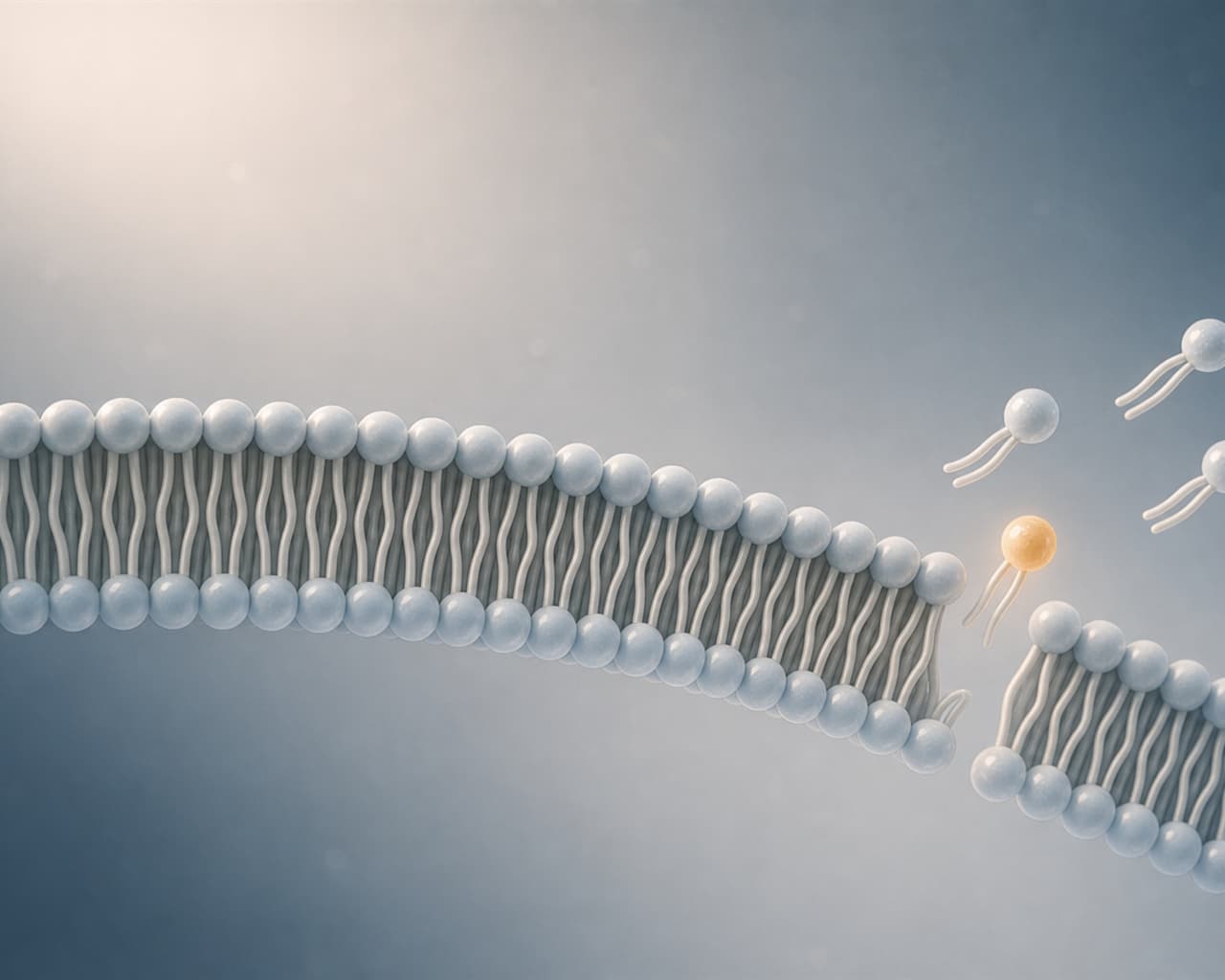
Most discussions of citicoline stop at acetylcholine, treating it as simply a way to deliver choline for the brain's attention-and-memory neurotransmitter. That is only half of its story, and arguably the less distinctive half. What sets citicoline apart from a plain choline pill is its connection to the machinery that builds and repairs the membranes of brain cells. Neurons are, to a first approximation, membrane: their long axons, their branching dendrites, and above all their synapses are all made of the same lipid bilayer, and the health of that membrane is inseparable from the health of the cell. Citicoline feeds the pathway that manufactures the membrane's main building block. Whether that biochemical fact translates into a meaningful benefit for a healthy brain is a separate question, and an honest look at citicoline and membranes has to hold both the elegant mechanism and its uncertain payoff in view at once.
Why membranes are the point
The membrane of a neuron is not a passive wrapper. Its dominant components are phospholipids, chiefly phosphatidylcholine and phosphatidylethanolamine, which together make up more than half of the phospholipids in animal cell membranes [1], along with phosphatidylserine, the major negatively charged phospholipid enriched in neural tissue [9]. These molecules do more than form a barrier. Membrane composition shapes how embedded proteins behave, and phosphatidylserine in particular helps anchor and activate signalling proteins that keep neurons alive [9]. Because synapses are essentially specialized membrane, the capacity to synthesize phospholipids is directly tied to the capacity to build and remodel the connections that underlie learning. Anything that supports phospholipid synthesis is, at least in principle, supporting the raw material of neural plasticity.
Membranes are constantly remodeled
A neuronal membrane is not laid down once and left alone. Phospholipids are continually broken down and resynthesized as cells remodel their synapses, repair small damage, and adjust to activity, so maintaining a membrane is an ongoing manufacturing task rather than a one-off construction. That is precisely why the regulated enzyme at the heart of the phospholipid-synthesis pathway continuously adjusts its rate of production to match what the cell needs [3]. It is also why a steady supply of the pathway's inputs is more than a theoretical concern, since a cell that is perpetually rebuilding its membranes carries a constant, if modest, demand for choline and for the nucleotide precursors that assemble the phospholipid. The interest in citicoline flows directly from this picture of perpetual turnover, because a compound that supplies both of those inputs is, in principle, feeding a process that never stops.
The Kennedy pathway, and where citicoline sits in it
Cells build phosphatidylcholine through a well-characterized route known as the Kennedy pathway, or the CDP-choline pathway. Choline is first phosphorylated to phosphocholine, then combined with a cytidine nucleotide to form cytidine diphosphate-choline, and finally joined to a lipid backbone to yield phosphatidylcholine [1][2]. The step that controls the overall rate of this pathway is catalyzed by the enzyme CTP:phosphocholine cytidylyltransferase, a regulated, membrane-sensing enzyme that speeds up or slows down phospholipid production according to the cell's needs [3]. The reason this matters for the supplement is a small but striking coincidence of names. Cytidine diphosphate-choline, the pathway's central intermediate, is citicoline. Supplemental citicoline is, in effect, the very molecule that sits at the heart of membrane phospholipid synthesis.
Swallowed citicoline does not travel to the brain in one piece. It is broken down into choline and cytidine, which circulate separately and are taken back up by brain cells to resynthesize the CDP-choline intermediate internally [4]. A human study confirmed that oral citicoline raises both plasma choline and plasma uridine, the form the cytidine component takes in human blood [16]. This is where the second half of the molecule earns its keep. Uridine and cytidine are converted inside cells to the cytidine nucleotides that the Kennedy pathway requires, so they directly feed the same phospholipid-synthesis machinery [8]. Citicoline therefore supplies two of the pathway's inputs at once, the choline and the nucleotide precursor, which is the mechanistic basis for describing it as a phospholipid precursor rather than merely a choline source [5].
Membrane breakdown, and the case for repair
The interest in citicoline for membranes grew largely out of what goes wrong with membranes in injury and disease. When brain tissue is starved of oxygen, as in a stroke, or degenerates, as in Alzheimer's, one of the characteristic events is the breakdown of neuronal membranes. This is driven substantially by the activation of enzymes called phospholipases, especially phospholipase A2, which cleave phospholipids and release damaging free fatty acids [11]. The signature of this process is measurable: postmortem Alzheimer's cortex shows reduced phosphatidylcholine and phosphatidylethanolamine alongside raised levels of their breakdown products, a pattern of accelerated membrane degradation not seen in several other brain diseases [10]. Elevated choline-containing breakdown products serve as markers of exactly this membrane loss [11].
Against that backdrop, citicoline's proposed role is twofold: to supply the precursors that let cells rebuild phosphatidylcholine, and to blunt the phospholipase-driven degradation that tears membranes down. In animal models of cerebral ischemia, CDP-choline restored membrane phospholipids and attenuated the release of free fatty acids, and these mechanisms became the leading explanation for its neuroprotective effects in preclinical work [6][7]. This is a coherent and appealing account of how a phospholipid precursor might protect and maintain neuronal membranes under stress.
The precursor-combination idea, and human biomarker evidence
A related line of research widened the concept from citicoline alone to a combination of membrane precursors. The observation was that building synaptic phospholipids requires not just choline but also a source of cytidine nucleotides, in the form of uridine, and the omega-3 fatty acid docosahexaenoic acid to serve as the lipid backbone. Supplying all three together was shown in animals to raise brain phosphatide levels and synaptic proteins, promoting the formation of synaptic membrane [12]. This "phosphatide precursor" principle became the rationale for a specific nutrient combination developed for early Alzheimer's disease, designed to provide the membrane building blocks and cofactors thought to be lacking [13].
Crucially, some of this has been tested in humans, at the level of biomarkers rather than clinical outcomes. Using magnetic resonance spectroscopy, researchers showed that oral uridine raised the membrane-phospholipid precursor pool in the human brain [14], and that six weeks of citicoline improved markers of frontal-lobe energy metabolism in healthy adults [15]. These are the strongest direct human links between supplementation and membrane-related brain chemistry. They are also, importantly, measures of chemistry rather than of memory or thinking, which is the crux of the honest reading that follows.
What is established, and what is inferred
Here the mechanism and the payoff have to be separated cleanly. The biochemistry is solid. Citicoline genuinely is a Kennedy-pathway intermediate, it genuinely delivers choline and a nucleotide precursor to human circulation, and in injury models it genuinely restores phospholipids and limits their breakdown. That much is not in dispute. What remains inferred is the leap from this mechanism to a meaningful clinical benefit of "membrane maintenance" in a healthy or aging brain. Much of the membrane-repair evidence is preclinical, and where citicoline has been tested in large human outcome trials for acute stroke and traumatic brain injury, the pivotal studies were neutral, which has kept even its clinical role a matter of ongoing debate [4]. The human evidence that does exist for membrane effects, the spectroscopy studies, demonstrates changes in brain chemistry without yet demonstrating that those changes produce better cognition in people who are well.
There is a deeper reason for caution, one that connects to the wider theme of precursor supplements. A healthy, well-nourished brain is not obviously short of choline or cytidine, and the enzyme that governs phospholipid synthesis is regulated to match production to need rather than to raw-material abundance [3]. Supplying more of an input that was not the limiting factor may simply be absorbed into the body's normal metabolism without changing any outcome. This does not render citicoline inert, because injury and aging can create genuine shortfalls and genuine membrane breakdown that extra precursor might help address [10][11]. It does mean that the strongest case for citicoline's membrane effects lies in states of damage or decline, and that extending that case to a healthy brain is an extrapolation the current evidence supports only loosely.
This is the same distinction that runs through all careful supplement science: a plausible, well-documented mechanism is a reason to investigate, not a proof of benefit. Citicoline's membrane story is unusually strong on the mechanistic side, stronger than most supplements can claim, because the pathway is understood in detail and the molecule sits precisely within it. That is genuinely to its credit. But the maintenance of brain-cell membranes in a healthy person, and any cognitive dividend from it, sits in the gap between mechanism and outcome, supported by biochemistry and biomarker data rather than by definitive results. The right posture is neither dismissal nor confidence but calibrated interest: an elegant and real mechanism whose everyday benefit remains, for now, more inferred than shown.
References
[1] Gibellini, F., & Smith, T. K. (2010). The Kennedy pathway: de novo synthesis of phosphatidylethanolamine and phosphatidylcholine. IUBMB Life, 62(6), 414–428. https://doi.org/10.1002/iub.337
[2] Fagone, P., & Jackowski, S. (2013). Phosphatidylcholine and the CDP-choline cycle. Biochimica et Biophysica Acta, 1831(3), 523–532. https://doi.org/10.1016/j.bbalip.2012.09.009
[3] Cornell, R. B., & Ridgway, N. D. (2015). CTP:phosphocholine cytidylyltransferase: function, regulation, and structure of an amphitropic enzyme required for membrane biogenesis. Progress in Lipid Research, 59, 147–171. https://doi.org/10.1016/j.plipres.2015.07.001
[4] Grieb, P. (2014). Neuroprotective properties of citicoline: facts, doubts and unresolved issues. CNS Drugs, 28(3), 185–193. https://doi.org/10.1007/s40263-014-0144-8
[5] Secades, J. J. (2016). Citicoline: pharmacological and clinical review, 2016 update. Revista de Neurología, 63(Suppl 3), S1–S73. https://pubmed.ncbi.nlm.nih.gov/28417449/
[6] Adibhatla, R. M., Hatcher, J. F., & Dempsey, R. J. (2002). Citicoline: neuroprotective mechanisms in cerebral ischemia. Journal of Neurochemistry, 80(1), 12–23. https://doi.org/10.1046/j.0022-3042.2001.00697.x
[7] Adibhatla, R. M., & Hatcher, J. F. (2005). Cytidine 5′-diphosphocholine (CDP-choline) in stroke and other CNS disorders. Neurochemical Research, 30(1), 15–23. https://doi.org/10.1007/s11064-004-9681-8
[8] Cansev, M. (2006). Uridine and cytidine in the brain: their transport and utilization. Brain Research Reviews, 52(2), 389–397. https://doi.org/10.1016/j.brainresrev.2006.05.001
[9] Kim, H. Y., Huang, B. X., & Spector, A. A. (2014). Phosphatidylserine in the brain: metabolism and function. Progress in Lipid Research, 56, 1–18. https://doi.org/10.1016/j.plipres.2014.06.002
[10] Nitsch, R. M., Blusztajn, J. K., Pittas, A. G., Slack, B. E., Growdon, J. H., & Wurtman, R. J. (1992). Evidence for a membrane defect in Alzheimer disease brain. Proceedings of the National Academy of Sciences, 89(5), 1671–1675. https://doi.org/10.1073/pnas.89.5.1671
[11] Klein, J. (2000). Membrane breakdown in acute and chronic neurodegeneration: focus on choline-containing phospholipids. Journal of Neural Transmission, 107(8–9), 1027–1063. https://doi.org/10.1007/s007020070051
[12] Wurtman, R. J., Cansev, M., Sakamoto, T., & Ulus, I. H. (2009). Use of phosphatide precursors to promote synaptogenesis. Annual Review of Nutrition, 29, 59–87. https://doi.org/10.1146/annurev-nutr-080508-141059
[13] van Wijk, N., Broersen, L. M., de Wilde, M. C., Hageman, R. J. J., Groenendijk, M., Sijben, J. W. C., & Kamphuis, P. J. G. H. (2014). Targeting synaptic dysfunction in Alzheimer's disease by administering a specific nutrient combination. Journal of Alzheimer's Disease, 38(3), 459–479. https://doi.org/10.3233/JAD-130998
[14] Agarwal, N., Sung, Y. H., Jensen, J. E., daCunha, G., Harper, D., Olson, D., & Renshaw, P. F. (2010). Short-term administration of uridine increases brain membrane phospholipid precursors in healthy adults: a 31-phosphorus magnetic resonance spectroscopy study at 4T. Bipolar Disorders, 12(8), 825–833. https://doi.org/10.1111/j.1399-5618.2010.00884.x
[15] Silveri, M. M., Dikan, J., Ross, A. J., Jensen, J. E., Kamiya, T., Kawada, Y., et al. (2008). Citicoline enhances frontal lobe bioenergetics as measured by phosphorus magnetic resonance spectroscopy. NMR in Biomedicine, 21(10), 1066–1075. https://doi.org/10.1002/nbm.1281
[16] Wurtman, R. J., Regan, M., Ulus, I., & Yu, L. (2000). Effect of oral CDP-choline on plasma choline and uridine levels in humans. Biochemical Pharmacology, 60(7), 989–992. https://doi.org/10.1016/S0006-2952(00)00436-6